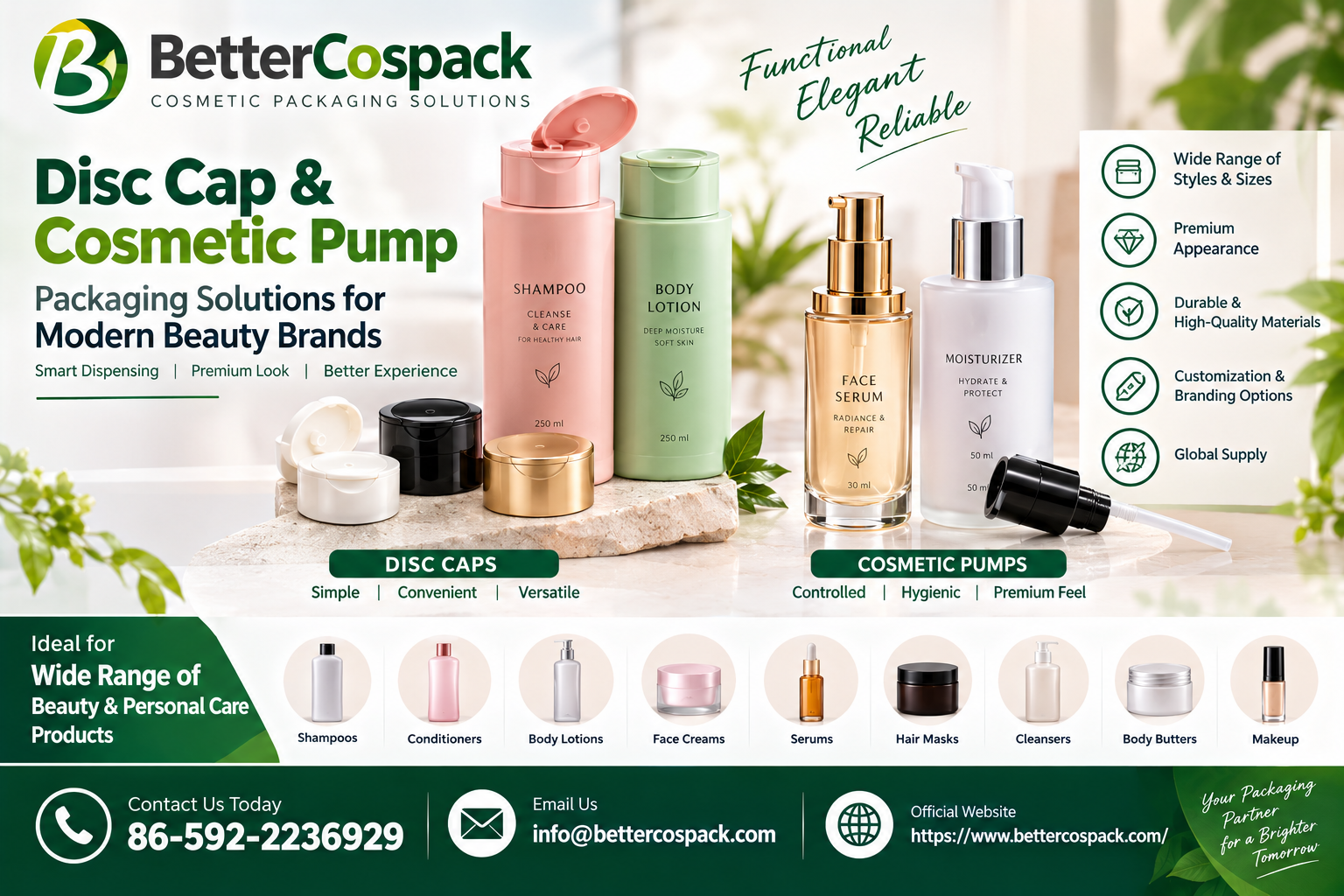
The beauty and personal care packaging industry is placing greater emphasis on dispensing convenience, controlled product delivery, and consumer-friendly packaging designs. As cosmetic brands introduce increasingly diverse skincare and personal care formulations, choosing suitable dispensing components has become an important product development decision.
A disc cap offers a convenient dispensing option for suitable squeezable bottles containing shampoos, conditioners, lotions, and other personal care products.
Meanwhile, a cosmetic pump provides a mechanical dispensing solution for formulations that benefit from controlled product delivery and convenient application.
Although both components serve similar packaging purposes, their operating mechanisms, material requirements, and consumer experiences are different.
For cosmetic manufacturers, private-label beauty brands, and packaging distributors, understanding these differences can help improve packaging functionality and product presentation.
Why Dispensing Systems Influence Consumer Experience
Consumers interact with packaging every time they use a skincare or personal care product.
An inconvenient closure can make an otherwise suitable product difficult to handle.
Similarly, a dispensing mechanism that releases an unsuitable amount of formulation may create unnecessary mess or product wastage.
These practical concerns make dispensing design an important part of packaging development.
Manufacturers should therefore consider how people open, dispense, handle, and store their products before selecting packaging components.
What Is a Disc Cap in Cosmetic Packaging?
A disc cap is a dispensing closure commonly used on suitable plastic bottles.
It generally features a hinged or pivoting top section that opens when pressure is applied to one side.
The opening allows the user to dispense the formulation by squeezing or tilting the bottle, depending on the product and container design.
Disc-top closures are commonly associated with shampoos, conditioners, lotions, and selected personal care formulations.
Their appeal comes from straightforward operation and compact construction.
However, proper performance depends on bottle compatibility, formulation viscosity, closure fit, and the dispensing opening.
A disc-top closure should not automatically be assumed suitable for every liquid or cream product.
How Cosmetic Pumps Support Controlled Dispensing
A cosmetic pump is a mechanical dispensing component designed to transfer a suitable formulation from its container through an outlet.
Many pump systems use an actuator, internal pumping mechanism, and dip tube, although designs vary.
When properly matched to a formulation, the pump can provide convenient and relatively consistent dispensing.
Common applications include hand lotions, liquid soaps, facial care products, and selected cosmetic creams.
Pump selection depends on product viscosity, container dimensions, dispensing requirements, and material compatibility.
The output per actuation should be evaluated according to the specific pump design.
A pump does not automatically guarantee precise dosing or complete protection from contamination.
Disc Cap vs Cosmetic Pump: Understanding the Differences
Both dispensing systems offer useful features, but they are not interchangeable in every application.
| Packaging Feature | Disc Cap | Cosmetic Pump |
| Dispensing Method | Opening and squeezing or tilting | Mechanical pump actuation |
| Typical Packaging | Squeezable bottles | Compatible rigid or flexible containers |
| Common Products | Shampoos, conditioners, body lotions | Lotions, liquid soaps, skincare products |
| Output Control | Depends on opening and user pressure | Depends on pump design and actuation |
| Construction | Relatively simple closure | Multiple functional components |
| Main Consideration | Bottle flexibility and closure suitability | Formula compatibility and pump performance |
The choice should reflect the complete packaging system rather than individual component appearance.
Why Formula Viscosity Is Important
Viscosity describes a fluid’s resistance to flow.
A thin liquid behaves differently from a thick lotion or cream during dispensing.
For disc-top packaging, the dispensing opening and bottle flexibility influence how easily the product can be released.
For pump packaging, the internal mechanism must be capable of handling the formulation’s flow characteristics.
Selecting an unsuitable system can result in inconsistent dispensing, excessive effort, or difficulty delivering the product.
Manufacturers should evaluate dispensing performance using the intended formulation rather than water or unrelated test liquids alone.
The Importance of Accessible Packaging Design
Packaging convenience is particularly relevant for consumers who prefer simple, comfortable product handling.
Some users may find certain closures difficult to operate because of grip limitations or reduced hand strength.
A thoughtfully designed dispensing system should consider actuator size, required operating force, and the ease of holding the container.
However, no dispensing format is universally easier for every consumer.
A disc closure may be convenient for one person, while a pump may be preferable for another.
Beauty brands can benefit from evaluating packaging usability with representative consumers before commercial production.
How Packaging Components Affect Product Protection
Disc caps and pumps must work with containers to maintain suitable package performance.
Improperly fitted closures can contribute to leakage or unwanted exposure.
Pump assemblies may also contain materials that interact with particular cosmetic ingredients.
Product protection depends on the complete formulation, closure design, container materials, and intended conditions of use.
Brands should assess relevant compatibility, leakage resistance, and microbiological considerations.
Packaging should never be described as fully contamination-proof without appropriate supporting evidence.
What Cosmetic Brands Should Test Before Ordering
Packaging approval requires more than checking product appearance.
Manufacturers should consider several practical assessments:
- Closure Compatibility: Confirm correct fitting with the selected bottle.
- Dispensing Performance: Evaluate product delivery using the intended formulation.
- Leakage Resistance: Check relevant sealing performance.
- Material Compatibility: Assess potential interactions with formulation ingredients.
- Consumer Usability: Review operating comfort and handling.
- Transport Performance: Evaluate resistance to applicable distribution conditions.
Clear acceptance criteria help packaging suppliers and cosmetic brands identify potential problems before larger production orders.
Sustainability and Dispensing Component Selection
Environmental considerations are influencing the development of cosmetic packaging components.
Brands may explore lightweight closures, reduced material usage, refillable systems, or designs compatible with established recycling processes.
Disc caps may offer relatively simple construction, while pumps typically contain multiple functional parts.
However, environmental performance cannot be determined from component count alone.
Material composition, durability, recyclability, and local waste-management systems all influence the overall result.
Manufacturers should support sustainability claims with appropriate evidence and avoid assuming that all plastic packaging offers identical recycling opportunities.
Frequently Asked Questions (FAQs)
1. What is a disc cap used for?
A disc cap is a dispensing closure commonly used on suitable bottles containing shampoos, conditioners, lotions, and other personal care formulations.
2. What is a cosmetic pump?
A cosmetic pump is a mechanical dispensing component that delivers suitable liquid or cream formulations from compatible cosmetic containers.
3. Which is better for lotion packaging: a disc cap or a cosmetic pump?
Both may be suitable. The best choice depends on lotion viscosity, container design, dispensing requirements, consumer preferences, and packaging compatibility.
4. Can cosmetic pumps dispense thick creams?
Certain pump designs can handle suitable thicker formulations, but their performance must be verified against the specific product’s characteristics.
5. How should brands select reliable cosmetic packaging components?
Brands should evaluate material compatibility, dispensing performance, closure dimensions, supplier documentation, consumer usability, and appropriate product testing.
Media Contact
Department: Cosmetic Packaging and Dispensing Solutions Enquiries
Contact: +86-592-2236727
Email: info@bettercospack.com
Official Website: https://www.bettercospack.com/
Read More:-