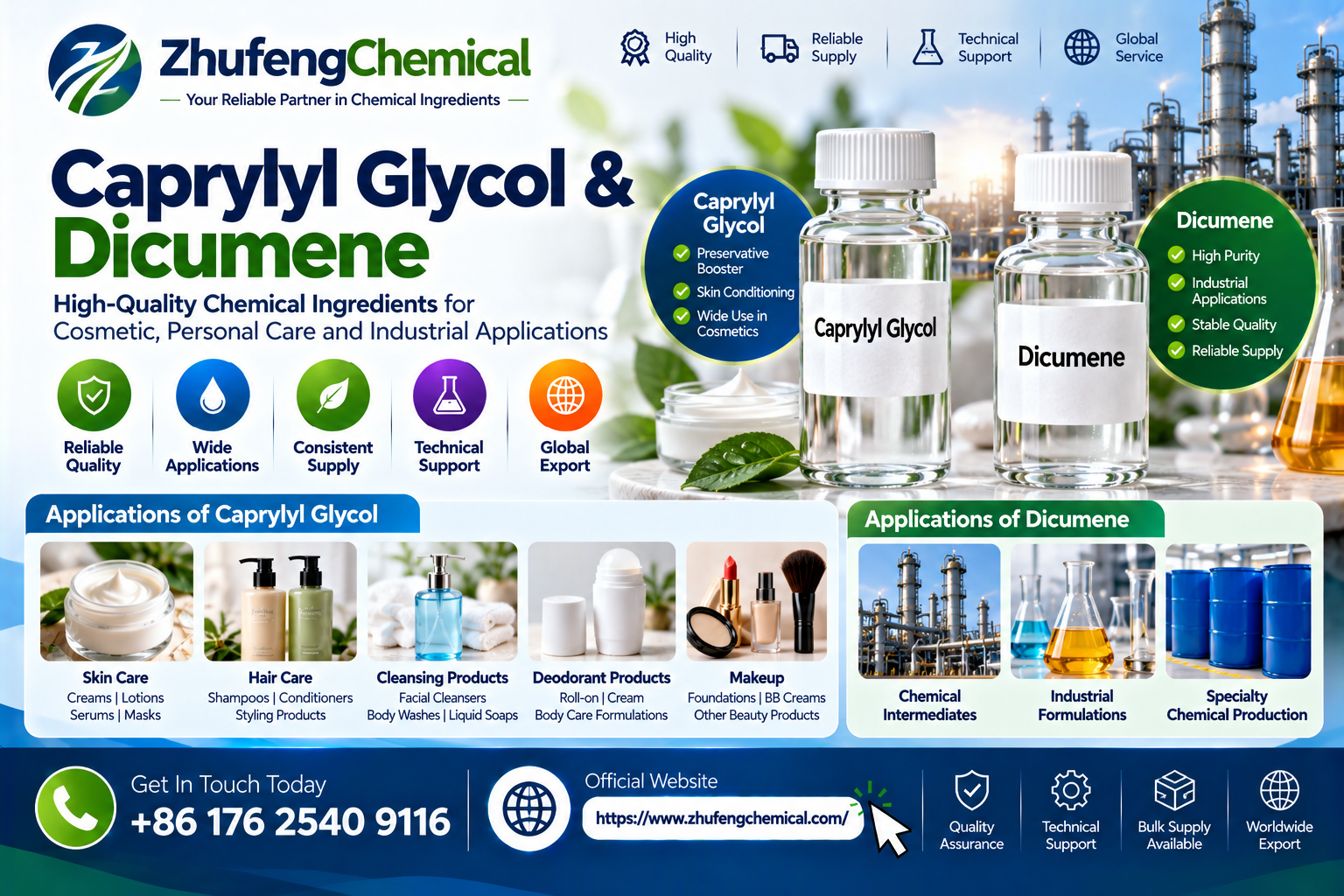
Specialty chemical industry is placing increasing emphasis on raw material consistency, chemical identification, and application-specific quality standards. As manufacturers develop more sophisticated products, the selection of appropriate chemical ingredients has become essential for achieving reliable performance and maintaining production efficiency.
Caprylyl Glycol is a multifunctional ingredient widely associated with cosmetic and personal care formulations. Its skin-conditioning properties and ability to support certain preservation systems make it relevant to various skincare applications.
Meanwhile, Dicumene represents a different area of industrial chemical sourcing, where precise chemical identification, composition, and intended application must be carefully established.
Although these materials serve different purposes, both highlight the importance of technical documentation, supplier transparency, and consistent quality control.
For cosmetic manufacturers, chemical distributors, formulation laboratories, and industrial buyers, understanding these considerations can support more informed purchasing decisions.
Why Chemical Identity Is Important in Manufacturing
Chemical names are important, but they do not always provide sufficient information for manufacturing decisions.
Commercial materials may differ in purity, composition, impurity profiles, or manufacturing specifications.
A product supplied under a familiar chemical name may not automatically meet the requirements of every application.
Manufacturers should therefore verify relevant identifiers, including Chemical Abstracts Service (CAS) numbers, where applicable.
This approach helps prevent unsuitable substitutions and supports more effective quality assurance.
What Is Caprylyl Glycol?
Caprylyl Glycol, chemically known as 1,2-octanediol, is a multifunctional ingredient commonly used in cosmetic and personal care products.
It is a glycol with skin-conditioning and moisture-supporting properties.
The ingredient can also contribute to the performance of selected cosmetic preservation systems.
Common applications include facial creams, body lotions, cleansers, haircare formulations, and other suitable personal care products.
However, its effectiveness depends on the complete formulation, including ingredient concentration, compatibility, and product characteristics.
Caprylyl Glycol should not automatically be considered a complete replacement for an adequately validated preservation system.
How Caprylyl Glycol Supports Cosmetic Product Development
Cosmetic manufacturers often seek ingredients capable of contributing to multiple formulation objectives.
Caprylyl Glycol can support skin-conditioning performance while complementing certain antimicrobial preservation strategies.
This makes it relevant to formulators seeking practical combinations of functional ingredients.
However, product stability depends on more than one raw material.
Emulsifiers, fragrances, oils, surfactants, water content, and packaging materials can influence finished-product behaviour.
Manufacturers should conduct suitable stability and microbiological testing before approving a formulation.
Understanding Dicumene in Industrial Chemical Sourcing
Dicumene is a chemical designation encountered in industrial sourcing discussions involving aromatic organic materials.
Because similar commercial names can refer to different chemical identities or compositions, buyers should confirm the exact substance using its CAS number, structural information, and technical specification.
This distinction is particularly important when purchasing materials for chemical processing, research, or specialised industrial applications.
Unlike Caprylyl Glycol, Dicumene should not be assumed to be a conventional cosmetic conditioning ingredient.
Any intended industrial application requires appropriate evaluation of chemical identity, purity, reactivity, compatibility, and handling requirements.
A verified technical data sheet and safety data sheet are essential starting points.
Caprylyl Glycol vs Dicumene: Understanding Their Different Roles
The two materials illustrate how different chemical categories require different purchasing and quality considerations.
| Comparison Factor | Caprylyl Glycol | Dicumene |
| Chemical Context | Multifunctional glycol | Industrial chemical designation requiring precise identity verification |
| Typical Industry Focus | Cosmetics and personal care | Specialised industrial chemical applications |
| Main Evaluation | Formulation compatibility and performance | Chemical identity and intended process suitability |
| Quality Consideration | Purity and relevant cosmetic-grade specifications | Composition, purity, and application-specific specifications |
| Documentation | COA, SDS, and formulation information | Verified identity, COA, SDS, and technical documentation |
| Purchasing Priority | Finished-product performance | Correct chemical grade and safe industrial use |
These substances should not be considered interchangeable.
Their suitability must be established independently according to the intended application.
Why Purity and Impurity Control Matter
Raw material purity can influence manufacturing consistency and finished-product quality.
Unwanted impurities may affect appearance, odour, chemical stability, or processing performance.
In cosmetics, ingredient quality can influence formulation characteristics and safety assessments.
For industrial chemicals, impurity profiles may affect reaction behaviour or downstream processing.
Manufacturers should establish suitable acceptance criteria and verify the information provided in certificates of analysis.
A consistent chemical specification helps reduce uncertainty during repeated production.
The Role of Quality Documentation
Chemical buyers should request documentation appropriate to the purchased material.
Important records may include:
- Certificate of Analysis: Provides relevant batch-specific testing information.
- Safety Data Sheet: Explains hazards and appropriate handling precautions.
- Technical Data Sheet: Describes relevant product characteristics and specifications.
- Chemical Identification: Confirms the CAS number and chemical identity.
- Storage Guidance: Defines appropriate material storage conditions.
- Traceability Information: Supports identification of raw material batches.
Documentation should be reviewed against the manufacturer’s actual requirements rather than accepted without verification.
Storage and Handling Considerations
Different chemicals can require different storage and handling arrangements.
Manufacturers should review chemical-specific hazards, temperature requirements, container compatibility, and personal protective measures.
For Caprylyl Glycol, appropriate storage helps maintain material quality for intended formulation applications.
For Dicumene, handling requirements must be based on the confirmed chemical identity and its verified safety information.
Businesses should never assume that chemically unrelated substances can be stored or transported under identical conditions.
Personnel should receive appropriate training for their responsibilities.
Building Reliable Specialty Chemical Supply Chains
Consistent raw material sourcing helps manufacturers manage quality expectations and production planning.
A suitable supplier should provide clear product specifications, accurate documentation, and reliable communication regarding material identity.
Buyers should discuss intended applications and acceptance requirements before purchasing.
Where appropriate, incoming material inspection or additional analytical testing can support verification.
Effective supplier relationships depend on transparency rather than unsupported promises.
This approach can benefit cosmetic manufacturers, industrial chemical processors, research organisations, and specialised formulation businesses.
Frequently Asked Questions (FAQs)
1. What is Caprylyl Glycol used for?
Caprylyl Glycol is commonly used in skincare, haircare, and personal care formulations for its skin-conditioning properties and ability to support certain preservation systems.
2. Is Caprylyl Glycol a preservative?
It can enhance selected preservation systems, but its inclusion alone does not guarantee adequate microbial protection in a finished cosmetic product.
3. What is Dicumene used for?
Its intended industrial application should be determined from the exact chemical identity, verified composition, and relevant technical documentation rather than the commercial name alone.
4. Are Caprylyl Glycol and Dicumene interchangeable?
No. They represent different chemical materials with distinct characteristics and application requirements.
5. How can manufacturers select reliable specialty chemical suppliers?
Manufacturers should evaluate chemical identification, product specifications, certificates of analysis, safety documentation, traceability, and consistency of supply.
Media Contact
Department: Cosmetic Ingredients and Industrial Specialty Chemicals
Contact: +86 176 2540 9116
Email: sales@zhufengchemical.com
Official Website: https://www.zhufengchemical.com/
Read More:-