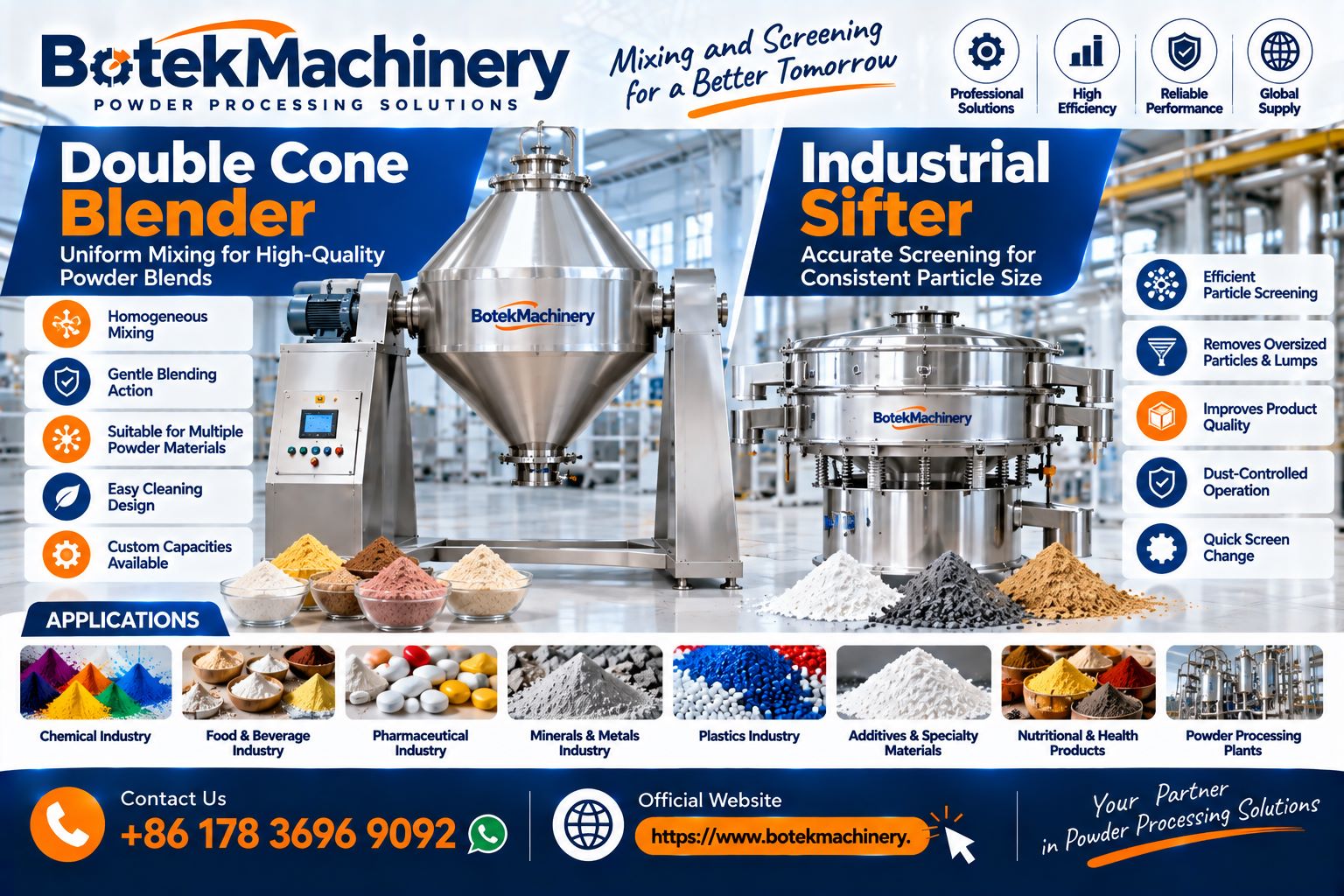
Industrial manufacturers are placing greater emphasis on powder consistency, ingredient distribution, and production quality across food processing, chemical manufacturing, pharmaceuticals, and speciality material industries.
A double cone blender provides a rotating mixing system designed to combine suitable dry powders and granules through controlled tumbling. Meanwhile, an industrial sifter helps separate materials according to particle size, remove oversized particles, and support screening requirements.
Although these machines perform different operations, they can complement each other within an appropriately designed powder processing system.
For manufacturing companies, production engineers, and quality control professionals, understanding the relationship between blending and screening can help improve product consistency, reduce processing errors, and support reliable manufacturing outcomes.
Why Powder Uniformity Is a Manufacturing Priority
Powder-based products often contain multiple ingredients with different physical characteristics.
Differences in particle size, density, shape, and flow behaviour can influence how materials mix and move through equipment.
When ingredients are distributed unevenly, the finished product may fail to meet its intended specifications.
Similarly, unwanted oversized particles can affect subsequent processing or product appearance.
This makes equipment selection and process validation important parts of powder manufacturing.
What Is a Double Cone Blender?
A double cone blender is an industrial mixing machine featuring a rotating vessel formed from two connected conical sections.
As the vessel rotates, suitable dry materials tumble and redistribute through gravity-driven movement.
The mixing action is generally relatively gentle compared with high-shear processing systems.
Important Features
- Tumbling Mixing Action: Supports blending of suitable free-flowing materials.
- Enclosed Vessel: Helps contain materials during operation.
- Batch Processing: Suitable for defined production quantities.
- Gentle Handling: Can benefit materials that do not require intensive mechanical mixing.
- Discharge Arrangement: Provides a designated outlet for the blended product.
Mixing performance depends on the formulation, equipment design, loading conditions, and operating parameters.
What Is an Industrial Sifter?
An industrial sifter is equipment used to separate powders or granular materials according to particle size through a screening medium.
Depending on the equipment, screening may involve vibration, centrifugal action, or other suitable mechanical methods.
The process allows particles meeting the screen opening requirements to pass through while retaining larger material.
An industrial sifter may support raw material preparation, quality screening, or finished-product inspection.
However, screening efficiency depends on powder properties, screen selection, equipment design, and processing conditions.
Why Screening Before Blending Can Be Important
Raw materials may contain lumps, agglomerates, or particles outside the desired size range.
Introducing these materials directly into a blender can affect the resulting mixture.
An industrial screening stage may help remove unwanted oversized material before mixing.
For example, a powdered food ingredient containing occasional lumps may require appropriate screening before entering the blending vessel.
This can improve material preparation, although it does not guarantee blend uniformity.
Manufacturers should determine whether preliminary screening is appropriate for the formulation.
Understanding Material Segregation During Mixing
One of the important challenges in powder blending is segregation.
Materials with different particle sizes or densities may separate during mixing, transfer, or discharge.
A longer mixing process does not always resolve this problem.
In certain formulations, excessive handling can increase separation rather than improve uniformity.
A double cone blender is generally more appropriate for materials with suitable flow characteristics.
Highly cohesive powders or formulations requiring significant deagglomeration may need different mixing technologies.
Manufacturers should evaluate actual material behaviour through representative production trials.
Double Cone Blender and Industrial Sifter: Different Processing Functions
| Processing Factor | Double Cone Blender | Industrial Sifter |
| Main Function | Mixing dry materials | Particle size separation |
| Operating Principle | Rotating tumbling vessel | Screening through a selected medium |
| Primary Objective | Ingredient distribution | Removal or separation of particles |
| Common Application | Powder and granule blending | Raw material and product screening |
| Quality Consideration | Blend uniformity | Screening efficiency |
| Process Position | Mixing stage | Before or after mixing, as appropriate |
Both machines support powder processing, but neither can automatically replace the function of the other.
When Should Industrial Screening Occur?
The position of screening equipment depends on the manufacturing objective.
Screening before blending may help prepare individual ingredients and remove unwanted particles.
Screening after blending may support the removal of oversized material from a finished mixture.
However, post-blending screening requires careful evaluation.
If ingredients differ in particle size, screening may disproportionately remove certain components and alter the formulation.
Therefore, downstream screening must be validated to ensure that product composition remains within specification.
The correct process sequence depends on material characteristics and quality requirements.
Factors Affecting Double Cone Blender Performance
Several operating conditions influence blending performance.
Batch Loading: The amount of material should remain within the manufacturer’s recommended operating limits.
Rotational Speed: Suitable rotation supports the required tumbling movement.
Material Flowability: Free-flowing materials may behave differently from cohesive powders.
Particle Characteristics: Differences in size, density, and shape can affect mixing behaviour.
Discharge Method: Product handling after blending can influence segregation.
Rather than relying on a universal mixing cycle, manufacturers should establish suitable operating parameters through testing.
Quality Control and Mixing Validation
Consistent blending requires more than visual inspection.
Manufacturers may collect representative samples to evaluate ingredient distribution within a batch.
The appropriate analytical method depends on the formulation and product requirements.
For screening operations, quality checks may assess particle size distribution, retained material, and screen integrity.
Process monitoring can help identify differences between expected and actual performance.
These activities support controlled manufacturing and provide useful information for production improvement.
Hygiene, Cleaning, and Cross-Contamination Prevention
Powder processing equipment must be selected according to the industry’s hygiene and contamination requirements.
A double cone blender should provide suitable access or validated procedures for cleaning product-contact surfaces.
An industrial sifter may require inspection of screens, seals, and material discharge areas.
Residual powders can create cross-contamination risks when equipment handles different formulations.
For combustible powders, appropriate dust hazard assessment and engineered safeguards are essential.
Equipment should not be considered suitable for hazardous or hygienic applications without verifying its specifications and applicable requirements.
Choosing Equipment for a Powder Processing Facility
Manufacturers should evaluate machinery based on specific production requirements.
Important considerations include:
- Material Properties: Flowability, particle size, moisture, and cohesiveness.
- Batch Capacity: Suitable equipment volume and operating limits.
- Mixing Requirements: Required uniformity and material sensitivity.
- Screen Specifications: Appropriate mesh opening and screening performance.
- Cleaning Needs: Suitable construction and product-contact accessibility.
- Process Integration: Compatibility with feeding, discharge, and material transfer systems.
Testing representative materials before purchasing can help identify potential processing limitations.
Frequently Asked Questions (FAQs)
1. What is a double cone blender used for?
A double cone blender is used to mix suitable dry powders and granules through a rotating tumbling action, commonly in batch manufacturing processes.
2. What is the purpose of an industrial sifter?
An industrial sifter separates materials according to particle size and can help remove oversized particles or unwanted agglomerates.
3. Can a double cone blender mix powders with different densities?
It may mix certain formulations containing density differences, but segregation risks must be evaluated through suitable blending trials.
4. Should powder screening happen before or after blending?
Screening position depends on the formulation and quality objective. Pre-blending screening prepares ingredients, while post-blending screening requires validation to avoid altering composition.
5. Which industries use double cone blenders and industrial sifters?
Suitable applications may include food ingredients, chemicals, pharmaceuticals, speciality materials, and other powder-based manufacturing operations.
Media Contact
Department: Industrial Mixing and Powder Processing Machinery Enquiries
Contact: +86 178 3696 9092
Email: sales@botekmachinery.com
Official Website: https://www.botekmachinery.com/