The growing use of interactive electronic devices is influencing how manufacturers design communication interfaces between people and machines. From industrial control equipment and medical instruments to self-service kiosks and smart appliances, touchscreen technology is creating opportunities for more intuitive product operation.
A Touch Panel Display combines visual information with touch-based interaction, allowing users to operate compatible devices directly through the screen. Similarly, an lcd touch screen integrates liquid crystal display technology with a suitable touch-sensing system to deliver responsive graphical interfaces.
For electronics manufacturers, equipment developers, and technology distributors, understanding touchscreen usability, integration requirements, and environmental performance is essential for developing reliable interactive products.
Why User Experience Is Becoming a Major Design Consideration
Electronic devices frequently require users to navigate menus, adjust settings, and monitor operating conditions.
Traditional control panels rely on physical buttons, switches, and separate indicators. Touchscreen interfaces can consolidate selected functions into one interactive surface.
However, touchscreen integration requires more than adding a touch-sensitive layer to an LCD.
Manufacturers must consider interface design, touch accuracy, operational safety, and the physical environment.
What Is a Touch Panel Display?
A Touch Panel Display is an interactive display assembly that allows users to provide input by touching designated areas of the screen.
Depending on its construction, it may combine an LCD, touch sensor, controller electronics, and protective cover glass.
The touch system detects user input and communicates it to the device’s processor, which interprets the interaction.
Common Features
- Direct Interaction: Allows users to select on-screen controls.
- Graphical Navigation: Supports menus, icons, and interactive instructions.
- Compact Design: Combines visual output and user input.
- Custom Interfaces: Accommodates application-specific controls.
- Touch Feedback: Supports software-based visual responses.
- Flexible Integration: Available in configurations suited to different devices.
Actual performance depends on the display, sensor, controller, and software implementation.
Understanding LCD Touch Screen Technology
An lcd touch screen combines a liquid crystal display with a compatible touch-input system.
The LCD presents visual content, while the touch sensor detects user interaction.
These components operate together but perform different functions.
The display determines visual characteristics such as resolution, brightness, and contrast. The touch layer influences input accuracy, sensitivity, and interaction capabilities.
Typical Applications
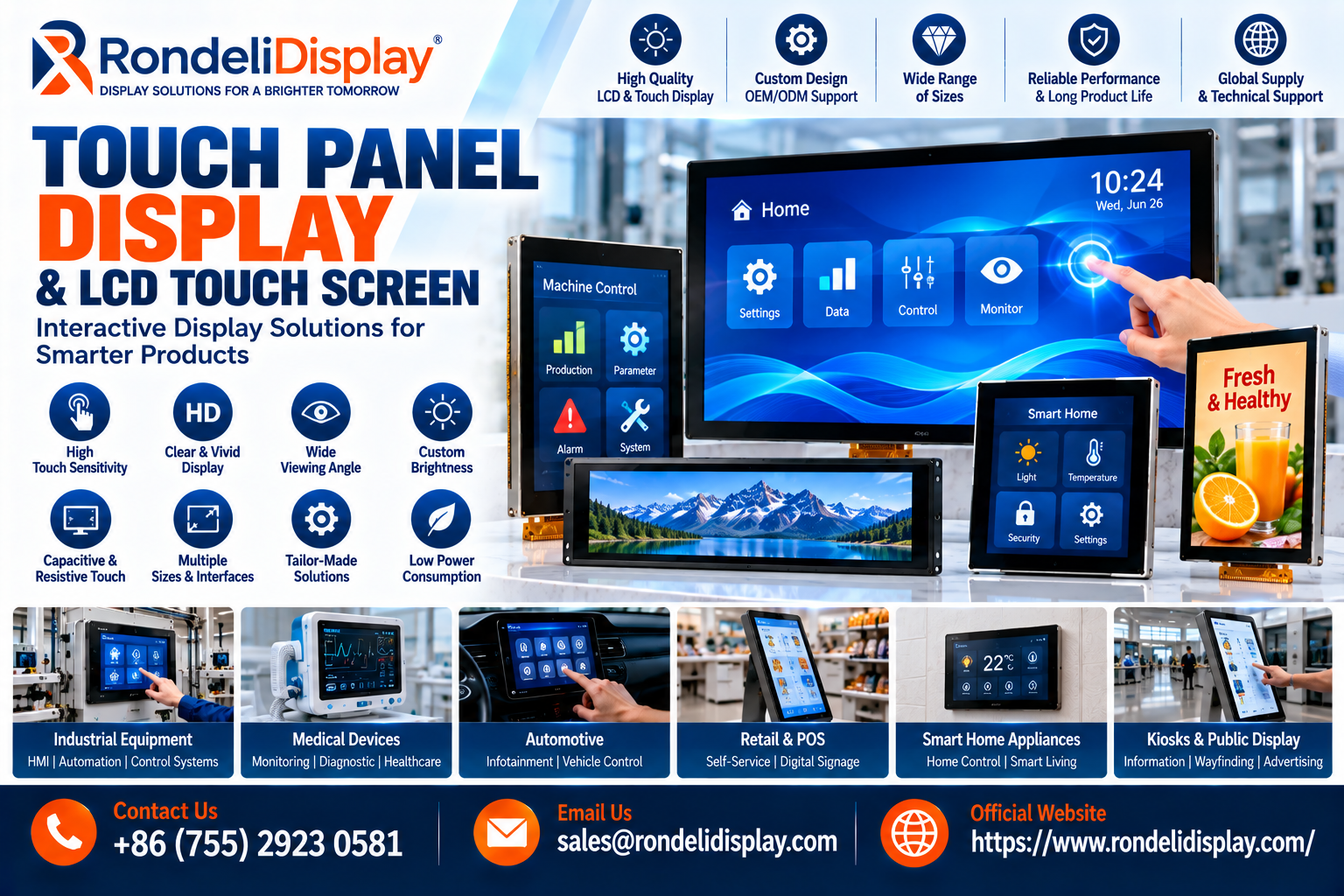
Industrial Equipment: Machine settings and operating information.
Medical Instruments: Compatible user controls and equipment status displays.
Retail Kiosks: Self-service navigation and transaction interfaces.
Smart Home Devices: Appliance settings and connected-home controls.
Office Equipment: Printer and equipment configuration menus.
Commercial Terminals: Interactive information and service applications.
Each application requires appropriate mechanical, electrical, and software integration.
Capacitive vs. Resistive Touch Technology
Two common touchscreen approaches are projected capacitive and resistive sensing.
| Feature | Capacitive Touch | Resistive Touch |
| Operating principle | Detects changes in capacitance | Detects applied pressure |
| Multi-touch | Commonly supported | Depends on design |
| Input method | Compatible fingers and conductive inputs | Pressure from suitable objects |
| Visual construction | Often uses transparent conductive layers | Uses flexible layered construction |
| Main consideration | Electrical and environmental compatibility | Surface durability and input pressure |
Capacitive touch is popular in consumer electronics because of its smooth interaction characteristics.
Resistive touch remains useful for selected industrial applications where pressure-based operation is preferred.
Neither technology is universally superior.
Designing Interfaces That Reduce Operator Errors
Touchscreen effectiveness depends heavily on user-interface design.
Small buttons, unclear menus, and poorly positioned controls can increase mistakes even when the hardware performs correctly.
A suitable Touch Panel Display should support readable content and logical navigation.
Important Design Principles
- Use clearly labeled controls.
- Provide adequate spacing between touch targets.
- Maintain readable text and contrast.
- Give immediate visual feedback.
- Make important functions easy to locate.
- Provide confirmation for consequential actions.
Safety-critical functions may require independent physical controls rather than touchscreen operation alone.
Cover Glass and Optical Bonding
Protective cover glass can influence appearance, mechanical durability, and touch performance.
Manufacturers may select different glass thicknesses, surface treatments, and decorative printing options.
Optical bonding involves joining suitable display layers using transparent bonding materials.
Under appropriate conditions, it can reduce internal reflections and improve perceived image clarity.
However, bonding also influences manufacturing complexity, repairability, and cost.
The correct configuration depends on the intended application.
Environmental Challenges for Touchscreen Equipment
Touchscreens installed in industrial or commercial environments may encounter dust, vibration, moisture, electrical interference, and temperature variation.
These conditions can affect display visibility or touch detection.
Important Engineering Considerations
Glove Operation: Requires compatible touch-sensing technology and configuration.
Moisture Exposure: May interfere with certain touch systems.
Electromagnetic Interference: Can affect sensitive electronics.
Temperature Range: Must match the equipment’s intended environment.
Cleaning Requirements: Surface materials should tolerate approved cleaning procedures.
Manufacturers should validate the complete assembled product under realistic operating conditions.
Why Touch Accuracy and Response Matter
A touchscreen should identify intended user inputs consistently.
Poor calibration, electrical noise, unsuitable controller settings, or software delays can reduce usability.
Touch accuracy is particularly important when interfaces contain numerous closely positioned controls.
Performance testing should evaluate input location, response consistency, and operation across the usable screen area.
An lcd touch screen must also be assessed as part of the complete product because processor performance and interface software influence the overall interaction.
Customization for Commercial Electronics
Standard touchscreen modules meet many product requirements, but some applications need customized solutions.
Common Customization Options
- Display dimensions and resolution.
- Touch sensor configuration.
- Cover glass dimensions.
- Decorative border printing.
- Connector and cable arrangements.
- Brightness requirements.
- Suitable optical bonding.
Customization should begin with technical drawings, interface specifications, and intended operating conditions.
Prototype evaluation helps identify compatibility issues before commercial production.
Selecting a Reliable Touchscreen Supplier
Electronics buyers should evaluate more than display size and price.
A suitable supplier should provide clear technical documentation, sample evaluation opportunities, and information about supported configurations.
Important considerations include electrical compatibility, touch controller support, optical performance, mechanical tolerances, and quality inspection.
For specialized equipment, buyers should also review environmental testing requirements and component availability.
Frequently Asked Questions (FAQs)
1. What is a Touch Panel Display?
It is an interactive display that allows users to provide input directly through a touch-sensitive screen.
2. What is an lcd touch screen?
It combines an LCD with a compatible touch sensor for visual output and user interaction.
3. What is capacitive touch technology?
It detects touch input through changes in electrical capacitance.
4. What is resistive touchscreen technology?
It detects input through pressure applied to a layered touch sensor.
5. Can touchscreen displays work with gloves?
Some can, depending on touch technology, controller configuration, and glove properties.
Media Contact
Department: Interactive LCD and Touchscreen Display Solutions
Email: sales@rondelidisplay.com
Official Website: https://www.rondelidisplay.com/