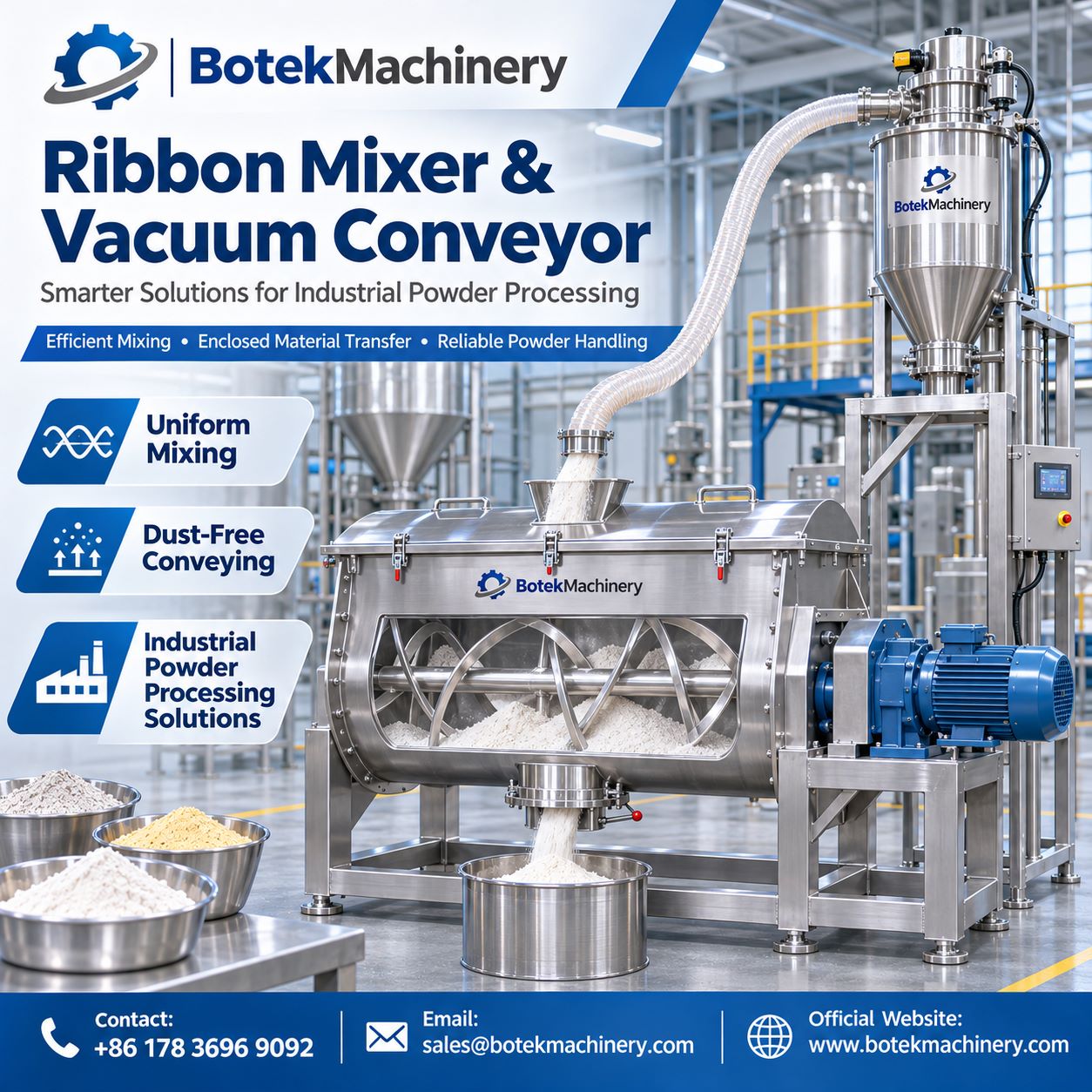
As industrial manufacturers focus on improving production efficiency, maintaining product consistency, and reducing manual material handling, integrated powder processing equipment is becoming an important consideration across manufacturing sectors. The ribbon mixer plays a significant role in blending dry powders and granular materials, while the vacuum conveyor provides a controlled solution for transferring compatible materials between processing stages.
From food production and pharmaceutical manufacturing to chemicals, cosmetics, and specialty materials, businesses require equipment that supports reliable processing, consistent output, and safer working conditions.
Combining effective mixing technology with suitable automated material transfer systems can help manufacturers streamline production workflows and reduce avoidable operational interruptions.
Ribbon Mixer: An Essential Machine for Industrial Powder Blending
A ribbon mixer is an industrial mixing machine designed to blend dry powders, granules, and certain other compatible materials inside a horizontal mixing chamber.
The equipment typically contains a rotating shaft fitted with inner and outer helical ribbons. These mixing elements move materials in different directions, encouraging circulation and distribution throughout the vessel.
This mixing action can support uniform blending when the machine is appropriately designed and operated.
Common industrial applications include:
- Food Processing: Blending flour-based ingredients, spices, seasoning powders, and dry mixes.
- Chemical Manufacturing: Combining compatible powdered chemicals and industrial additives.
- Pharmaceutical Processing: Mixing appropriate ingredients under validated manufacturing procedures.
- Cosmetic Manufacturing: Blending suitable powdered cosmetic ingredients.
- Animal Feed Production: Mixing dry feed ingredients and nutritional additives.
- Construction Materials: Processing compatible dry mortar ingredients and powdered formulations.
Vacuum Conveyor: Advancing Automated Material Transfer
A vacuum conveyor is an industrial conveying system that uses a pressure difference to transport suitable powders, granules, or other bulk solids through a pipeline.
The system typically creates negative pressure at a receiving unit, drawing materials from a feeding point into a controlled transfer arrangement.
Depending on the application, vacuum conveying equipment may include a vacuum generator, transport pipeline, filter receiver, discharge valve, and monitoring controls.
Important applications include:
Powder Loading: Transferring materials from storage containers into suitable mixing equipment.
Food Manufacturing: Moving compatible dry ingredients between production stages.
Pharmaceutical Production: Supporting enclosed material transfer where appropriate hygiene controls are implemented.
Chemical Processing: Handling suitable powdered raw materials in controlled systems.
Packaging Operations: Supplying compatible bulk materials to downstream filling equipment.
A properly designed conveying system can reduce open handling and help limit dust release, although performance depends on material characteristics and equipment configuration.
How Ribbon Mixer and Vacuum Conveyor Work Together
Integrating a ribbon mixer with a vacuum conveyor can create a more organized powder handling and blending process.
Rather than relying entirely on manual loading, manufacturers can use vacuum conveying equipment to deliver ingredients from suitable storage or feeding stations into the mixer.
A typical production process may involve:
- Preparing and inspecting raw powder materials.
- Positioning ingredients at the designated feeding station.
- Transferring materials through a vacuum conveying pipeline.
- Discharging the materials into the mixing chamber.
- Blending ingredients according to established processing parameters.
- Checking the finished mixture against quality requirements.
- Discharging the blended product into suitable downstream equipment.
This integrated arrangement can help reduce repetitive handling and support more consistent production planning.
However, the conveying system must be appropriately designed to prevent material segregation, excessive particle damage, or inconsistent feeding.
Key Advantages of Ribbon Mixer Technology
The ribbon mixer offers several operational benefits for compatible industrial blending applications.
Efficient Material Circulation: Helical ribbons encourage movement throughout the mixing chamber.
Batch Processing: Suitable equipment configurations support controlled production batches.
Processing Versatility: Different designs can handle a range of powders and granular materials.
Customizable Construction: Material-contact surfaces, discharge arrangements, and mixing elements can be selected according to application requirements.
Process Integration: Ribbon mixers can be connected with suitable conveying, feeding, and discharge systems.
Despite these advantages, highly cohesive materials, fragile particles, or formulations with significant density differences may require special consideration.
Mixing trials are valuable for determining equipment suitability.
Benefits of Vacuum Conveyor Systems in Manufacturing
A properly configured vacuum conveyor can offer practical advantages for industrial material handling.
These include reduced manual lifting, enclosed powder transfer, improved workplace organization, and easier integration with automated processing systems.
In facilities where airborne dust is a concern, suitable enclosed conveying arrangements and filtration equipment can help reduce material escape.
Vacuum conveying systems may also support flexible equipment layouts where traditional mechanical conveyors would require additional space or complex arrangements.
However, vacuum conveying is not suitable for every material. Highly abrasive, sticky, moisture-sensitive, or fragile products may require specialized engineering.
Ribbon Mixer vs. Vacuum Conveyor: Understanding Their Functions
Although both machines support powder processing, they perform different operations.
| Feature | Ribbon Mixer | Vacuum Conveyor |
| Primary function | Mixing and blending | Material transportation |
| Working principle | Rotating helical ribbons | Pressure difference and airflow |
| Common materials | Compatible powders and granules | Suitable powders and bulk solids |
| Typical installation | Mixing and blending stations | Material feeding and transfer lines |
| Main objective | Achieving blend uniformity | Controlled material movement |
The two machines complement each other when integrated into an appropriately engineered production line.
Important Factors When Selecting Powder Processing Equipment
Industrial buyers should evaluate technical and operational requirements before purchasing machinery.
Key considerations include:
- Material particle size and bulk density
- Powder flowability and moisture sensitivity
- Required batch capacity and production throughput
- Mixing time and blend uniformity requirements
- Conveying distance and pipeline configuration
- Equipment cleaning and maintenance requirements
- Material-contact construction and contamination control
- Dust containment and relevant safety provisions
Facilities processing combustible powders must also assess dust explosion hazards, equipment grounding, ignition sources, and applicable explosion protection measures.
Representative material trials can help manufacturers confirm processing suitability before full-scale installation.
Maintenance and Long-Term Equipment Performance
Regular inspection and preventive maintenance help maintain equipment reliability.
Ribbon mixing systems require checks of mixing elements, bearings, seals, drives, and discharge components.
Vacuum conveying systems require inspection of filters, pipelines, valves, vacuum equipment, and connection points.
Operators should follow approved isolation and maintenance procedures before servicing machinery.
Appropriate cleaning and inspection schedules can also help reduce contamination risks and unplanned production interruptions.
Frequently Asked Questions (FAQs)
1. What is a ribbon mixer?
A ribbon mixer is an industrial blending machine that uses rotating helical ribbons to combine compatible powders and granular materials.
2. What is a vacuum conveyor?
A vacuum conveyor is equipment that uses negative pressure and airflow to move suitable bulk materials through a controlled pipeline.
3. Which industries use ribbon mixers?
Common applications include food processing, chemicals, pharmaceuticals, cosmetics, animal feed, and compatible construction material manufacturing.
4. Can a vacuum conveyor load a ribbon mixer?
Yes. A suitably engineered vacuum conveying system can transfer materials into a compatible ribbon mixing machine.
5. What is the main advantage of a ribbon mixer?
Its rotating ribbon elements promote material circulation and can support uniform blending of suitable dry ingredients.
6. Can vacuum conveyors reduce manual material handling?
Yes. Appropriately designed systems can automate selected material transfer activities and reduce repetitive manual loading.
7. Are ribbon mixers suitable for all powders?
No. Suitability depends on flowability, cohesiveness, particle characteristics, and the required mixing outcome.
8. Can vacuum conveyors handle food-grade materials?
Yes, when the equipment meets appropriate material compatibility, hygiene, cleaning, and food safety requirements.
9. What affects vacuum conveyor performance?
Material characteristics, pipeline length, conveying velocity, vacuum capacity, filtration, and system configuration influence performance.
10. How can manufacturers select a reliable equipment supplier?
Manufacturers should evaluate machinery specifications, application expertise, material testing capabilities, safety features, quality controls, and technical support.
Media Contact
Department: Industrial Machinery and Business Communications
Email: sales@botekmachinery.com
Contact: +86 178 3696 9092
Official Website: https://www.botekmachinery.com/