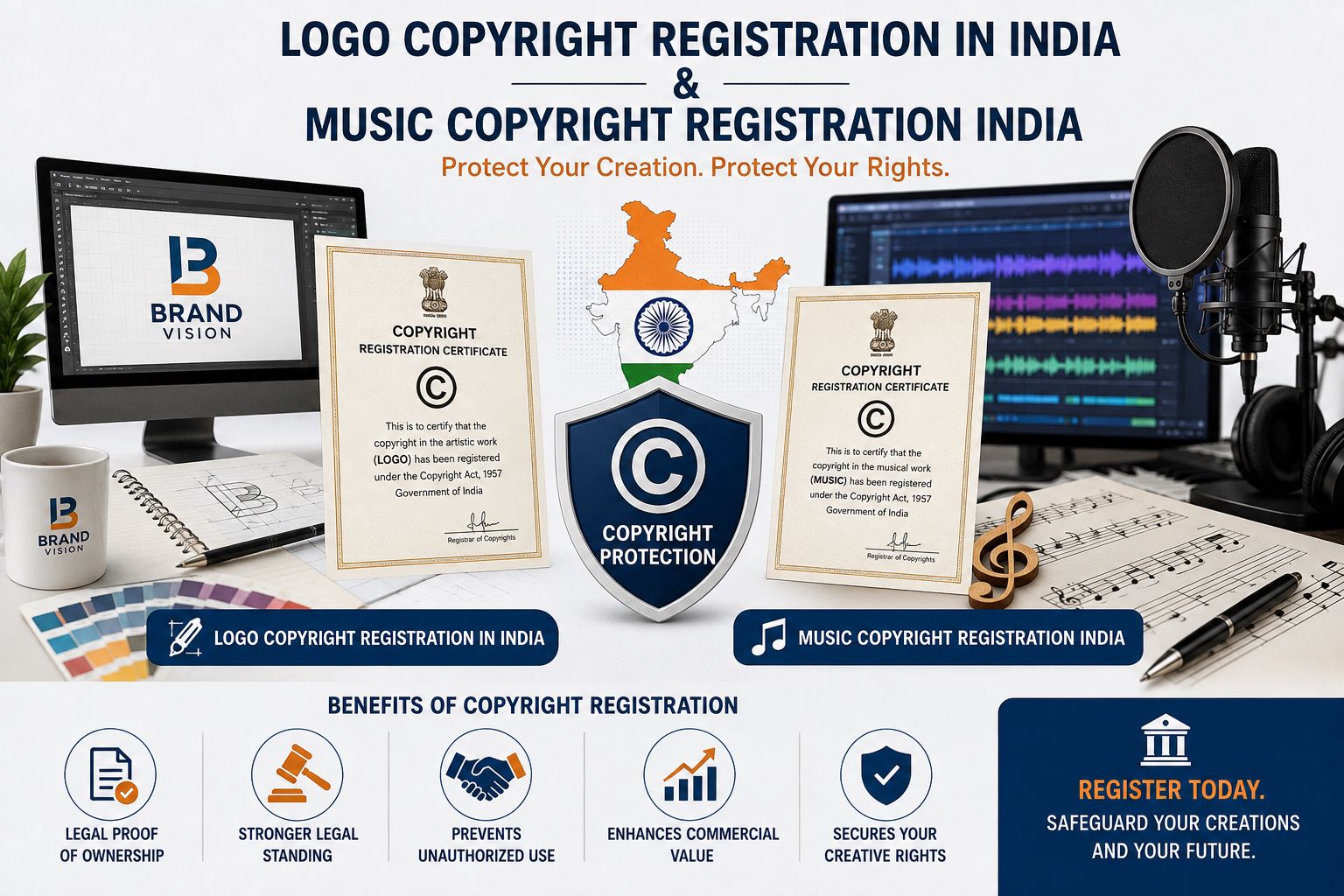
With Indian businesses, independent musicians and digital creators increasingly monetising their intellectual property online, copyright protection is gaining greater attention. Two areas attracting particular interest are Logo Copyright Registration in India and Music Copyright Registration India, as organisations and creators look for clearer ways to document ownership of original creative assets.
Logos now travel far beyond business cards and storefronts, appearing on websites, mobile applications, marketplaces, packaging and social media. Music follows a similarly digital path through streaming, video platforms, advertisements, films and short-form content.
The shift has created new commercial opportunities while also increasing the importance of understanding authorship, ownership, licensing and protection against unauthorised use.
Copyright Registration Gains Relevance in a Digital-First Market
India’s copyright system is primarily governed by the Copyright Act, 1957 and associated rules.
Copyright can subsist in qualifying original works without registration being mandatory. Registration, however, can provide an official record concerning the work and the ownership claimed by the applicant.
This distinction is increasingly relevant for businesses and creators whose intellectual property may be licensed, assigned or commercially exploited.
Rather than waiting for a dispute, rights holders are increasingly encouraged to maintain proper documentation from the beginning of a creative project.
Businesses Turn Attention to Logo Copyright Protection
A distinctive logo can become one of a company’s most recognisable commercial assets.
Where a logo contains qualifying original artistic expression, its artwork may potentially receive copyright protection. Logo Copyright Registration in India provides a formal mechanism through which eligible logo artwork can be registered.
The protection primarily concerns original artistic expression rather than the general idea behind the logo.
For example, a general concept involving a tree, globe or mountain cannot necessarily be monopolised through copyright. However, a designer’s particular original artistic representation may attract copyright protection if applicable legal requirements are satisfied.
Copyright and Trademark Protection Remain Distinct
Legal experts frequently highlight confusion between logo copyright and trademark registration.
While the same logo can potentially involve both intellectual property systems, their purposes differ considerably.
| Copyright | Trademark |
| Protects qualifying creative expression | Protects commercial brand identifiers |
| Relevant to original logo artwork | Relevant to brand recognition |
| Primarily addresses copying | Primarily addresses conflicting marketplace use |
| Governed by copyright legislation | Governed by trademark legislation |
Businesses considering Logo Copyright Registration in India should therefore separately assess whether trademark registration is appropriate.
Copyright may protect artistic elements, while trademark protection can be important where the logo identifies the commercial origin of goods or services.
Freelancer-Created Logos Raise Ownership Questions
The growing use of freelance designers and creative agencies has also brought copyright ownership into focus.
A business may pay a designer to create a logo and assume that payment automatically settles every intellectual property issue.
The actual position can depend on applicable law, the relationship between the parties and their contractual arrangements.
Businesses commissioning logos are therefore advised to maintain written agreements addressing:
- Authorship
- Copyright ownership
- Assignment of rights
- Commercial usage
- Territory where applicable
- Duration where applicable
- Consideration
- Rights retained by the designer
These records can become important when a company seeks investment, sells a brand or licenses its intellectual property.
How Logo Copyright Registration in India Generally Works
Applicants should first identify the artistic work and establish the chain of ownership.
The registration process broadly includes:
- Determining the appropriate copyright category.
- Preparing the prescribed application.
- Providing author and owner information.
- Submitting the logo artwork.
- Providing supporting documents where required.
- Paying the applicable government fee.
- Receiving a Diary Number.
- Monitoring the application.
- Addressing discrepancies or objections where applicable.
Additional procedural considerations can apply to artistic works used or capable of being used in relation to goods or services.
This makes accurate classification and documentation particularly important for commercial logos.
Music Industry Faces a More Complex Copyright Landscape
The growth of independent music and digital distribution has created another area of copyright awareness.
A musician can now compose, record and distribute a track internationally without following a traditional record-label model. At the same time, music can be copied, sampled, incorporated into videos or redistributed across platforms with remarkable speed.
Consequently, Music Copyright Registration India is becoming increasingly relevant for composers, lyricists, singers, producers and other rights holders.
However, music copyright is not always as straightforward as registering one finished song.
One Song Can Contain Multiple Copyright Works
A commercially released song can involve several separate legal interests.
| Song Element | Potential Legal Category |
| Original composition | Musical work |
| Original lyrics | Literary work |
| Recorded track | Sound recording |
| Vocal or instrumental performance | Performers’ rights may apply |
This distinction is important because ownership of one element does not automatically establish ownership of every other element.
For instance, a composer may hold rights relating to the musical work while another party may control rights associated with the sound recording, depending on the relevant legal and contractual arrangements.
Music Copyright Registration India Requires Correct Classification
Before filing for Music Copyright Registration India, applicants need to establish exactly which work they are seeking to register.
The composition, lyrics and final sound recording may need to be treated separately.
The registration process generally requires information about the work, author, copyright owner and publication status where applicable.
Supporting agreements or permissions may also become relevant when several parties are involved.
Creators should therefore establish a clear chain of rights before releasing or licensing music commercially.
Streaming and Social Media Increase Commercial Opportunities
Music today can generate value across an expanding range of channels.
Original tracks may appear in:
- Streaming services
- Films and television
- YouTube and online videos
- Social media campaigns
- Advertisements
- Mobile applications
- Games
- Podcasts
- Live events
- Corporate presentations
- Brand collaborations
Each commercial use can raise questions concerning permissions, royalties and licensing.
As a result, Music Copyright Registration India can be viewed as one element of a larger rights-management strategy rather than a standalone administrative exercise.
Licensing Becomes Central to Music Monetisation
Copyright ownership does not necessarily need to be transferred every time music is commercially used.
A copyright owner may instead grant a licence allowing another party to exercise specified rights under agreed conditions.
For example, a brand could obtain permission to use a musical composition in an online advertising campaign without acquiring complete ownership of the copyright.
Commercial licences may define:
- Type of permitted use
- Duration
- Territory
- Media
- Exclusivity
- Royalty or consideration
- Modification permissions
- Distribution rights
- Sub-licensing conditions
Assignments operate differently because they can involve transferring specified copyright interests.
For creators, understanding this difference can have significant long-term financial implications.
Copyright Registration Does Not Eliminate Infringement Risk
Registration should not be interpreted as technology that prevents copying.
A registered logo can still potentially be reproduced without permission. A registered song can still potentially be uploaded or used unlawfully.
Copyright owners may therefore need to monitor their intellectual property and take appropriate action when infringement occurs.
Depending on the circumstances, applicable law can provide civil remedies, while qualifying violations may also attract criminal consequences.
Registration can contribute to the evidence and documentation available to rights holders, but enforcement ultimately depends on the particular circumstances.
Frequently Asked Questions
1. What is Logo Copyright Registration in India?
It involves registering eligible original artistic elements of a logo through India’s copyright registration system.
2. Is logo copyright registration compulsory?
No. Copyright can generally subsist in eligible original works without registration.
3. Can a company logo receive copyright protection?
Qualifying original artistic elements of a logo may potentially receive copyright protection.
4. Is copyright registration the same as trademark registration?
No. They protect different intellectual property interests.
5. Can one logo receive both forms of protection?
Potentially yes, if the applicable requirements for copyright and trademark protection are satisfied.
6. What is Music Copyright Registration India?
It refers to registering qualifying musical and related works under India’s copyright framework.
7. Are song lyrics separate from the composition?
Yes. Original lyrics may constitute a literary work separate from the musical composition.
8. Is a sound recording separate from musical copyright?
Yes. A sound recording is legally distinct from the underlying musical work.
9. Can several people have rights connected to one song?
Yes. Composers, lyricists, performers and other parties may hold different rights depending on applicable law and agreements.
10. Can music copyright be licensed?
Yes. Copyright owners can grant defined usage rights through licensing arrangements.
https://newsgrow.blogspot.com/2026/08/logo-copyright-registration-in-india.html